
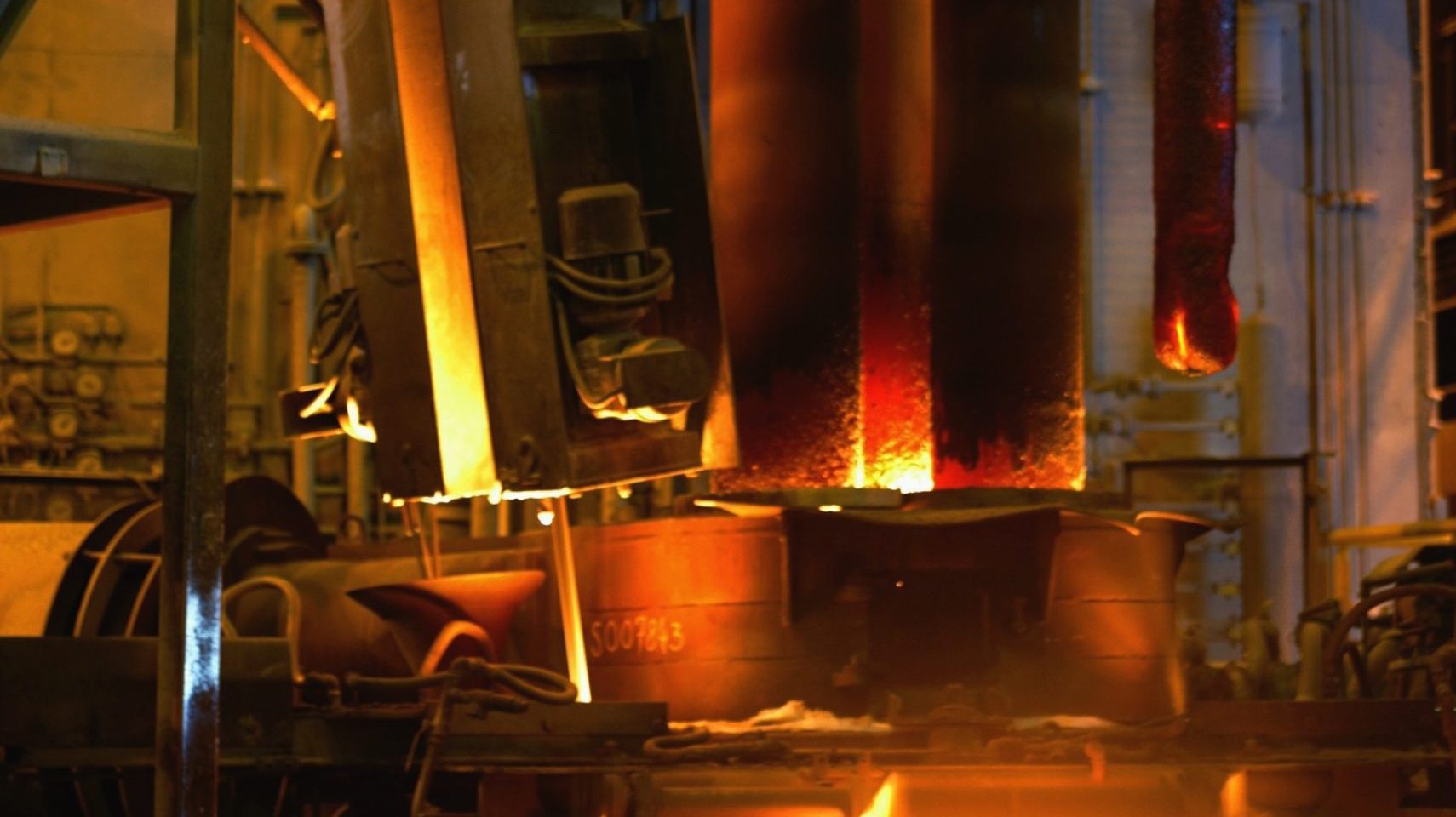
Luxmet has installed its optical emission spectroscopy (OES) based real-time and on-line monitoring technology to Swerim’s 5-tonne pilot Electric Arc Furnace (EAF) in Luleå, Sweden, as part of the EU-funded H2PlasmaRed project. The system is designed to provide real-time insight into the hydrogen plasma reduction process, supporting the development and scale-up of hydrogen plasma smelting reduction (HPSR) for low-carbon steelmaking.
As part of the installation, Luxmet’s OES is positioned to provide a direct optical view of the plasma inside the furnace. The measurement approach enables the collection of real-time information from high-temperature process phenomena that are otherwise difficult to observe.
Making the plasma process visible
Luxmet’s OES technology analyses light emitted by the process to provide information that can support process monitoring, analysis and control. Previous Luxmet research has demonstrated the potential of OES to provide real-time information on EAF conditions and support dynamic process control. Within H2PlasmaRed, the technology is being applied to HPSR. The project aims to develop HPSR for the reduction of iron ores and steelmaking sidestreams and demonstrate the technology at pilot scale, including through the retrofit of Swerim’s 5-tonne DC EAF.
“Real-time process information is essential when developing new steelmaking technologies. With OES, we can make the plasma process visible and generate data that can support process understanding and future process control.” says Dr. Xianfeng Hu, Senior researcher, Swerim.
From pilot scale towards industrial application
The H2PlasmaRed project aims to advance hydrogen plasma smelting reduction from technology readiness level (TRL) 5 to TRL 7, creating a pathway from pilot-scale development towards industrial application. The project also develops novel sensors and models to support process optimization in terms of reduction, resource and energy efficiency.
“Luxmet’s contribution brings real-time optical process monitoring into this development now that the project moves to its next stage with Swerim’s 5-tonne furnace – supporting the next generation of data-driven and hydrogen-based steelmaking.” states Dr. Henri Pauna, Coordinator of the H2PlasmaRed project, University of Oulu.
Learn more:
Luxmet · H2PlasmaRed
Further information
Pekka Huhtala
Business Development Manager
Email: pekka.huhtala@luxmet.fi
Phone: +358 50 436 0522
About Luxmet
Luxmet offers real-time control solutions based on analysis of light for high-temperature industrial processes such as electric furnaces, smelters, kilns, welding, and other metals processing. Luxmet’s unique and patented technology, based on OES, enhances process control, safety, and productivity in steel and other metals production and processing. A spin-off from the University of Oulu, Luxmet is the global leader in OES-based real-time control solutions for the steel and metal industry.
About Swerim
The Metal Research Institute Swerim conducts industry-oriented research and development on metals and their journey from raw material to finished product. Swerim aim to enhance the competitiveness of the industry through increased product quality, higher resource efficiency, and more sustainable manufacturing processes. Swerim vision is a sustainable and competitive industry. Swerim has unique expertise, unique experimental equipment, and unique testing facilities. Swerim operates in Luleå and Stockholm.
About H2PlasmaRed project
The main objective of H2PlasmaRed is to develop a green CO2-free steelmaking route based on H2-plasma technology while promoting a circular economy by valorizing industrial sidestreams to meet the targets of the European Green Deal for reducing CO2 emissions in the steel industry across Europe. The ambition is to introduce a near CO2 free reduction process to strive for the goal of Paris Agreement – a 90% reduction in the carbon intensity the steel production by 2050. The project is funded by Horizon EU.
